
Private LTE Networks for Rural Businesses: A Plain-English Guide
Commercial cellular coverage stops somewhere. For a lot of businesses across rural America, that somewhere is exactly where they operate. The carrier won’t come because the density isn’t there. The economics don’t work for Verizon or AT&T, so they don’t build. You’re left with dead zones, expensive hotspots, or connectivity so unreliable that it costs you real money every week.
The answer for a growing number of rural businesses, municipalities, and industrial operators isn’t waiting on the carriers. It’s building a private LTE or 5G network on their own terms.
What Private LTE Actually Means
Private LTE isn’t complicated in concept. You deploy your own radios, run your own core network software, and use your own spectrum to provide cellular connectivity for your staff, devices, and operations. It works the same way your phone connects to a cell tower, except that tower is yours and the network only serves your people.
You control who connects. You control what priority they get. You decide how the data is routed and secured. If you need coverage in a field, on a job site, inside a mine shaft, or across a rural campus that no carrier will ever touch, private LTE puts that coverage exactly where you need it.
The hardware has come a long way. Equipment from manufacturers like Baicells and Nokia delivers carrier-grade performance at a price point that makes ownership realistic for businesses well below the scale of a major enterprise. We sell and support both through TheEdgeMile.com, and we’ve deployed enough of it in the field to know where it performs well and where it doesn’t.
Need Coverage Where Carriers Don't Go?
If you have dead zones, high data bills, or need real control over your network, we've built them from the ground up. Let's talk about your situation.
Free site consultation. No obligation.
Schedule a site consultation
The Industries That Are Already Doing This
Private LTE isn’t theoretical. Across several industries, it’s become the standard answer to a connectivity problem that carriers will never solve.
Mining and extraction were early adopters because they had to be. Underground operations, remote surface sites, and large open-pit mines can’t depend on commercial coverage. Reliable communications are a safety requirement as much as an operational one. Private LTE gives miners voice, data, and IoT sensor connectivity across the entire site, including areas no tower would ever cover.
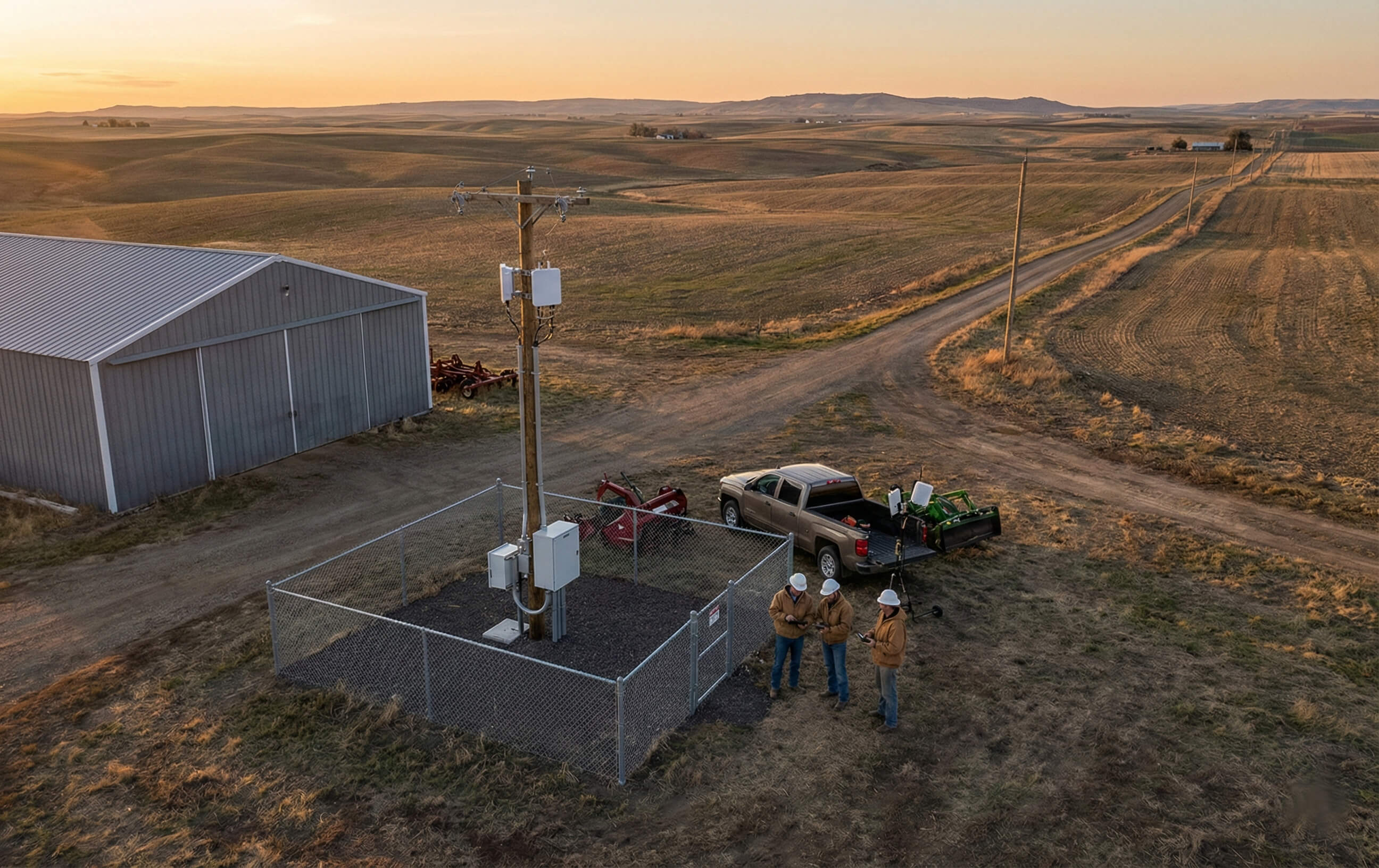
Agriculture and large rural operations face the same terrain problem without the same urgency to force a decision. But the economics are the same. A farm with multiple outbuildings, equipment spread across hundreds of acres, and workers who need reliable data access to do their jobs well doesn’t benefit from paying carrier rates for coverage that barely works. Private LTE covers the whole property at a fixed infrastructure cost.
Municipal governments and utilities are in a different position. They need reliable, secure communications for public safety, field crews, and infrastructure monitoring. Depending on commercial carriers for those functions means accepting someone else’s uptime guarantees and security policies. Building a private network gives local governments real control over the infrastructure their residents depend on, without that infrastructure going down every time the carrier has a problem.
Healthcare in rural areas carries stakes that commercial connectivity just can’t meet. Telehealth, medical device data, patient records, and staff communications all need reliable, secure networks. Rural hospitals and clinics that depend on spotty commercial coverage are taking on risk they don’t have to. Private LTE gives them a dedicated network built to their requirements, not averaged across millions of subscribers.
Construction and industrial sites are project-based environments where coverage needs to move and adapt. A large construction project might span hundreds of acres and run for years. Private LTE can be deployed quickly, expanded as the site grows, and reconfigured as operations shift. The alternative is a rotating circus of hotspots and signal boosters that never quite works.
We’ve Built This From the Ground Up
Centreville Tech doesn’t just consult on private networks. We’ve built them, operated them, and shipped the software that runs them.
Alabama Lightwave is our own rural ISP, built from scratch to serve customers in Alabama who have no other viable option. Not a resale arrangement, not a partnership with an existing carrier. We designed the network, secured the spectrum, deployed the equipment, and wrote the operational procedures. We run it. That experience gives us a ground-level understanding of what rural wireless deployment actually involves, including the parts that don’t show up in vendor documentation.
Through TheEdgeMile.com, we sell Baicells and Nokia LTE and 5G equipment to operators and integrators across the country. These are the same product lines going into serious deployments from ISPs to enterprise campuses to government networks. We stock them because we use them, and we support customers who need more than a box shipped to their door.
We also built Rapid5GS, a complete Evolved Packet Core designed for private network deployments. The EPC is the software that runs the LTE network underneath. It handles subscriber authentication, data routing, policy enforcement, and the dozens of other functions that happen every time a device connects. Commercial core software is expensive and designed for carrier scale. Rapid5GS is built for private network operators who need control, flexibility, and the ability to run on their own hardware without paying carrier licensing fees. Our software and hardware are running in networks across the United States.
What the Build Process Looks Like
Getting a private LTE network in the ground takes real planning. It’s not a product you configure and install in a day. The value we add comes from understanding that process and doing it right.
It starts with the site. Terrain, existing structures, interference sources, and the coverage footprint you need all drive equipment selection and placement. A flat industrial park deploys differently than a mine site with elevation changes and structures that kill signal. We do a real site assessment before we recommend anything.
Spectrum is the next question. CBRS spectrum is available without a license for most deployments and works well for private networks with moderate coverage needs. Licensed spectrum gives you more protection from interference and better propagation characteristics for larger footprints. The right answer depends on your location, your use case, and what frequencies will actually perform.
From there it’s equipment selection, core network configuration, backhaul design, and installation. We work through all of it as a single project, so nothing gets handed off between vendors who don’t talk to each other. When the network goes live, we stay involved. Monitoring, maintenance, and expansion are ongoing functions, not an afterthought.
When Private LTE Makes Sense
Private LTE isn’t the right answer in every situation. If commercial coverage works well for you and the cost is reasonable, there’s no reason to build infrastructure. The business case for private LTE gets compelling when coverage is genuinely absent or unreliable, when your data volumes make carrier costs hard to justify, or when you have security, compliance, or control requirements that a shared carrier network can’t meet.
Rural businesses with significant operations spread across land that no carrier will serve are the clearest case. Mining and agricultural operations almost always qualify. Industrial facilities with high device density and real-time data requirements often do. Municipalities that want to own their public safety communications infrastructure rather than rent it from a private company have strong reasons to consider it. Healthcare organizations with patient data and compliance obligations have their own calculus.
The honest answer is that it depends on your location, your scale, and your priorities. That’s why we start with a site consultation rather than a quote. We need to understand your operation before we can tell you whether private LTE makes sense and what it would actually cost.
Building the Right Network
Private LTE done well is an asset your organization owns and controls. Done poorly, it’s expensive infrastructure that underperforms and creates maintenance headaches. The difference is in the planning, the equipment choices, and the people who implement it.
We’ve built rural ISPs from nothing. We sell commercial-grade radio equipment to operators across the country. We wrote core network software running in private deployments nationwide. When we say we know how to do this, we’re describing what we’ve already done, not what we plan to do.
If you’re operating in an area with coverage problems, facing carrier costs that don’t make sense, or looking to build network infrastructure your organization owns outright, we’d like to talk about it. You can learn more about how we approach these projects on our private network deployment services page, or see how we’ve served telecom operators and rural ISPs.
Book a network consultation and we’ll assess your site, discuss your options, and give you a straight answer about what private LTE would actually look like for your operation.
Ready to Build Your Own Network?
We design, build, and operate private LTE and 5G networks across the USA. From a single-site deployment to a rural ISP, we handle the whole project.
Full deployment support, from spectrum planning to launch.
Discuss your network