
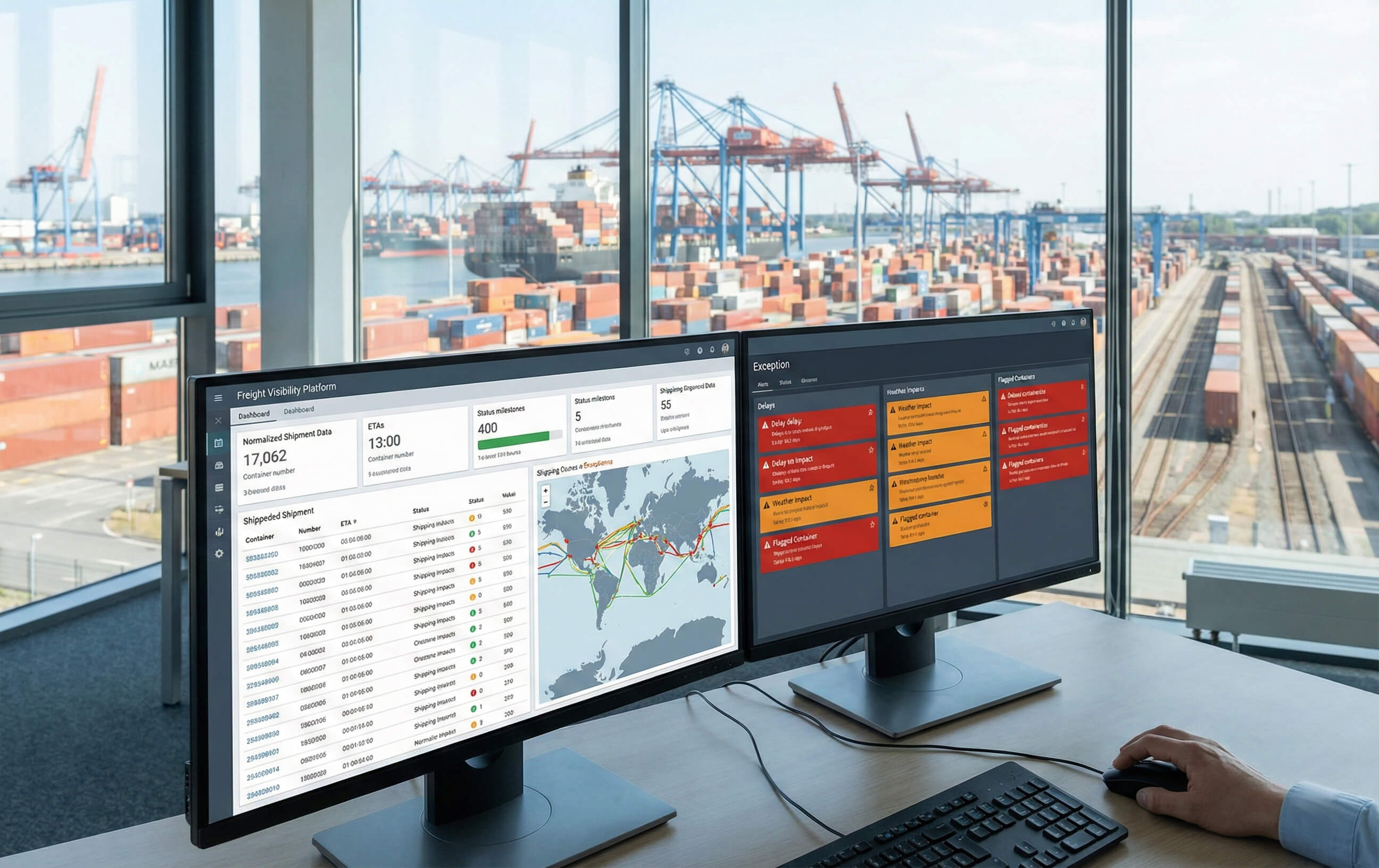
How to Build a Custom Freight Visibility Platform
Every freight forwarder and 3PL reaches a point where the patchwork stops working. Shipment status lives in ten different carrier portals. Someone on the operations team owns a spreadsheet that pulls it all together, manually, before client calls. When a customer asks where their cargo is, the answer involves checking three systems and calling a carrier rep. It’s slow, it’s error-prone, and it doesn’t scale.
The companies that outgrow this problem have two choices. Buy an off-the-shelf visibility platform and try to fit their operation into its assumptions, or build something designed specifically for how they actually work. For most straightforward operations, buying makes sense. For logistics and freight businesses with complex carrier relationships, unique data sources, or clients who need more than a generic portal, building is often the better investment.
What Freight Visibility Actually Requires
A visibility platform sounds simple until you start listing what it has to do. It needs to pull shipment status from dozens of data sources: direct carrier APIs, EDI feeds, third-party visibility networks like Project44, ocean data services like Ocean Insights, drayage platforms like DrayRates, satellite tracking providers, and major freight data services. Each of those sources has its own format, its own update frequency, its own quirks around what data is available and when. Normalizing all of that into a single coherent view of a shipment’s status is the core technical challenge, and it’s one we know well.
Beyond ingestion, the platform needs to hold that data in a structured way and apply business logic to it. Not every status update from a carrier means the same thing to every client. Some shipments have exception rules. Some clients need notifications at specific milestones. Some have reporting requirements that don’t map to how carriers report their own data. The rules layer is where a generic platform falls short and where custom software earns its cost.
Then there’s the output side. Operations teams need an internal view. Clients need a portal with the right level of detail for their needs. Some clients want data feeds into their own systems via API. Some need automated status emails or alerts. The visibility platform has to serve all of them without the operations team manually managing each one.
Still Tracking Freight by Hand?
If your team is managing shipment status through carrier portals, email, and spreadsheets, there's a better way. Let's talk about what a purpose-built visibility platform would look like for your operation.
Free consultation. No obligation.
Let's talk
What We Built for DNA Supply Chain Solutions
DNA Supply Chain Solutions is the clearest example of what this looks like when it’s done right. DNA manages international freight movements across a complex network of carriers, partners, and major retail clients. When we started working with them, their team was tracking shipments through exactly the kind of manual patchwork described above. The volume they were handling had grown to the point where the manual approach was a ceiling on the business.
We built SAMMIE, the Shipping Analytical Maritime Manager for Imports and Exports, as a purpose-built platform for their operation. The integration work alone tells the story of how specific this kind of project gets.
We built every integration to DNA’s specific operational needs, covering their carrier mix, their client reporting requirements, and the business rules that govern how their team manages exceptions.
On top of that data foundation, we built AI processing layers to turn raw shipment data into prediction and intelligence. This includes both deterministic AI, rules-based systems that apply consistent logic to structured data for exception detection, status classification, and workflow routing, and conditional AI that learns from patterns across shipments to surface predictions about delays, exceptions, and outcomes before they happen. The combination means SAMMIE doesn’t just show where a shipment is. It tells DNA’s team what is likely to happen next and flags the situations that need attention before they become problems.
The accounting automation was a separate layer on top of the visibility work. For major clients including Menards, SAMMIE handles the data exchange and invoice processing that previously required manual work at every step. Getting that right for a client operating at Menards’ scale meant meeting detailed EDI requirements and building automation that works reliably at volume without human review of each transaction.
DNA operates SAMMIE as the backbone of their freight visibility offering today. The platform scales with their volume without adding headcount, and their clients get the real-time visibility that major shippers now expect as a baseline requirement. See the full case study.
Why Off-the-Shelf Platforms Often Fall Short
The commercial visibility platforms are built for the common case. They connect to the major carriers and the major visibility networks. They provide portals that look reasonable and cover the functionality that most freight operations need most of the time.
Where they fail is in the specifics. Your carrier mix may include regional or specialized carriers that aren’t in the platform’s network. Your clients may have reporting requirements that the platform’s portal doesn’t support. Your business rules for exception handling may be different enough from the default behavior that the workarounds required to make the platform fit your operation end up costing more than building something clean would have.
There’s also the data ownership question. When your visibility data lives in a third-party platform, you’re dependent on that platform’s data model, their uptime, and their pricing decisions. Building on your own infrastructure, using open tools where they fit, keeps your data under your control and avoids the kind of vendor dependency that becomes expensive when the platform changes its terms or discontinues a feature you depend on.
What the Build Process Looks Like
A custom freight visibility platform is a significant project, and the right way to approach it is in phases. We start by mapping the actual data sources: which carriers, which third-party networks, which EDI trading partners, which satellite or specialized tracking providers. Each integration gets scoped individually because the complexity varies considerably. Connecting to a major carrier API with good documentation is different from parsing EDI from a legacy system with inconsistent output. The API and EDI integration work that ties these sources together is a core part of every platform we build.
The core platform, the database, the status normalization logic, the business rules layer, gets built alongside the integrations so that new data sources can be added without re-architecting the center. The AI layers come after the data foundation is solid. Deterministic systems need well-structured, reliable data to apply rules against. Predictive systems need enough historical data to identify meaningful patterns. Building the intelligence layer before the data layer is solid produces unreliable output that erodes trust in the whole platform. The client-facing portal and API layer complete the stack, giving operations teams, clients, and external systems a clean interface to everything underneath.
After launch, the work continues. Carrier APIs change. New trading partners have new requirements. Clients request new reports or new notification behaviors. A visibility platform is a living system, and we stay engaged with the clients we build them for.
When to Build
The honest answer to “should we build a custom visibility platform” depends on your volume, your carrier mix, and how differentiated your client requirements are. If you’re moving significant freight volume across a complex carrier network and your clients have specific visibility requirements that generic platforms don’t meet, a custom platform is likely the right investment. If your operation is more straightforward, a commercial product may serve you well enough that building isn’t justified.
The way to find out is to talk through your specific situation. We can look at your data sources, your client requirements, and your growth trajectory and give you an honest read on whether a custom platform makes sense and what it would take to build one.
Book a free consultation and let’s look at your operation. We’ll tell you straight whether building is the right move and what it would actually involve.
Ready to Build Your Own Visibility Platform?
We've built freight visibility platforms that integrate directly with major carriers, Project44, Ocean Insights, DrayRates, and satellite tracking providers. We can do the same for your operation.
Free 1-2 hour working session. Real scope and honest timeline.
Book a consultation